
- a daily visual exploration -
[chapter I]


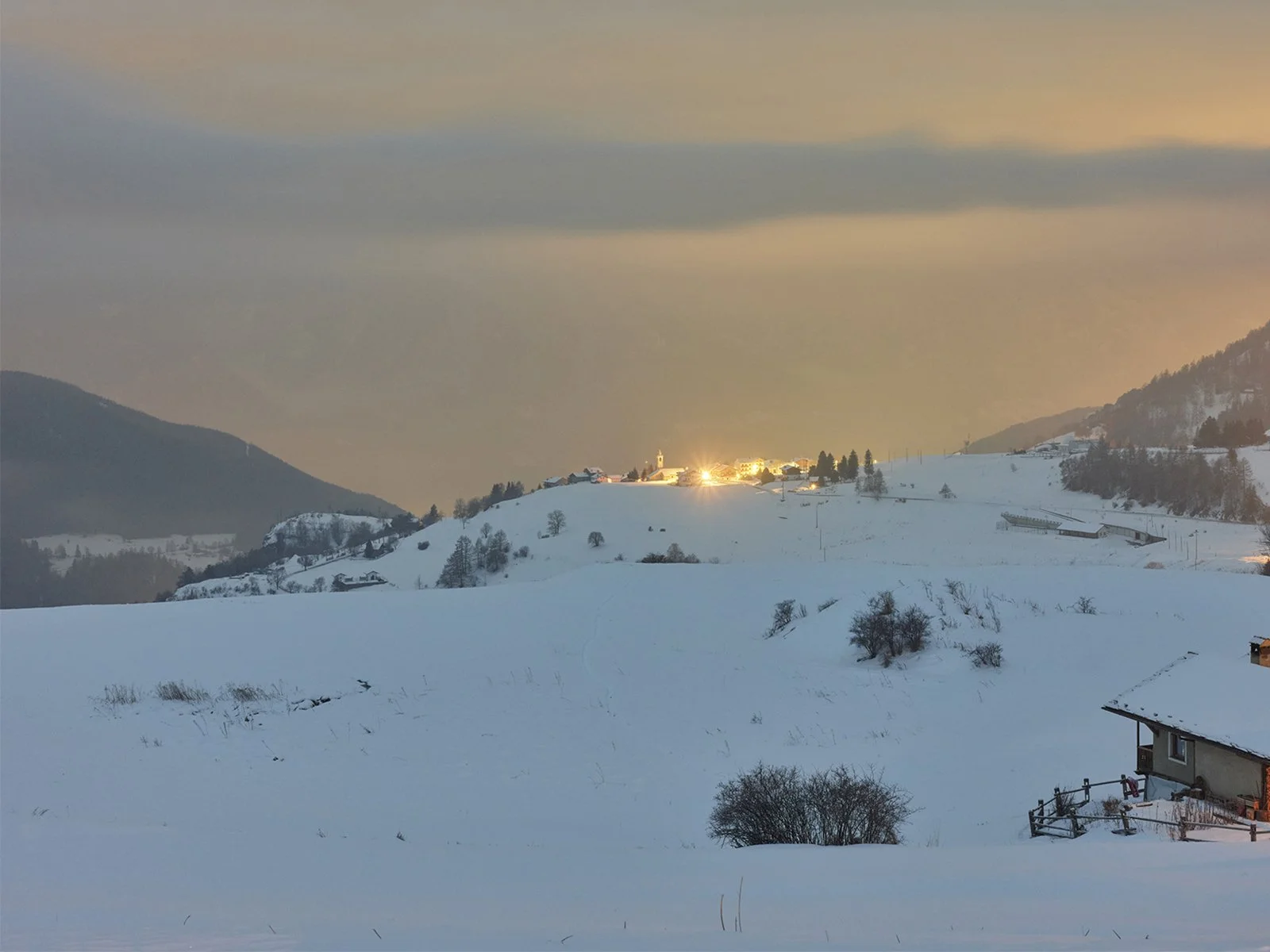

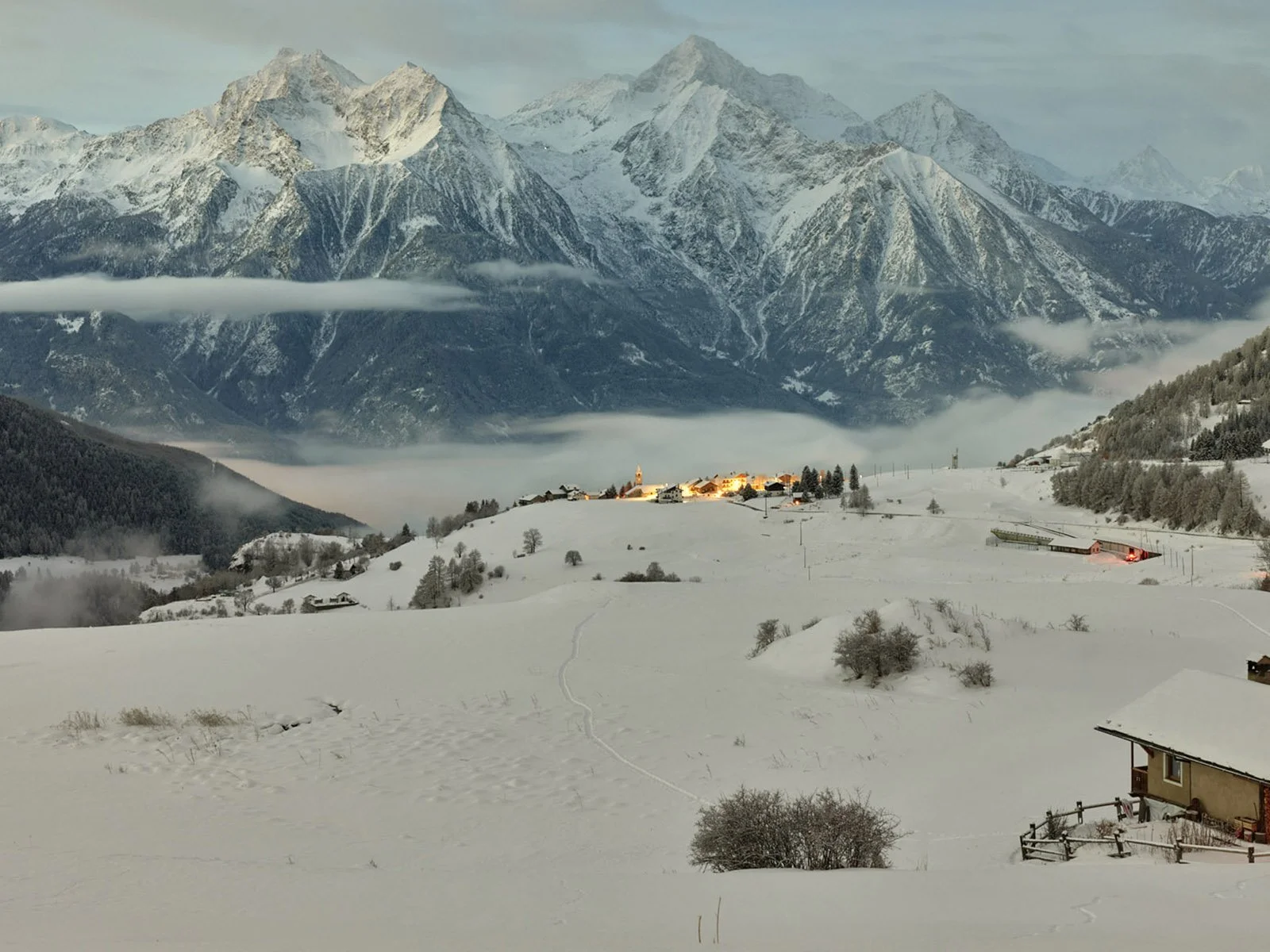


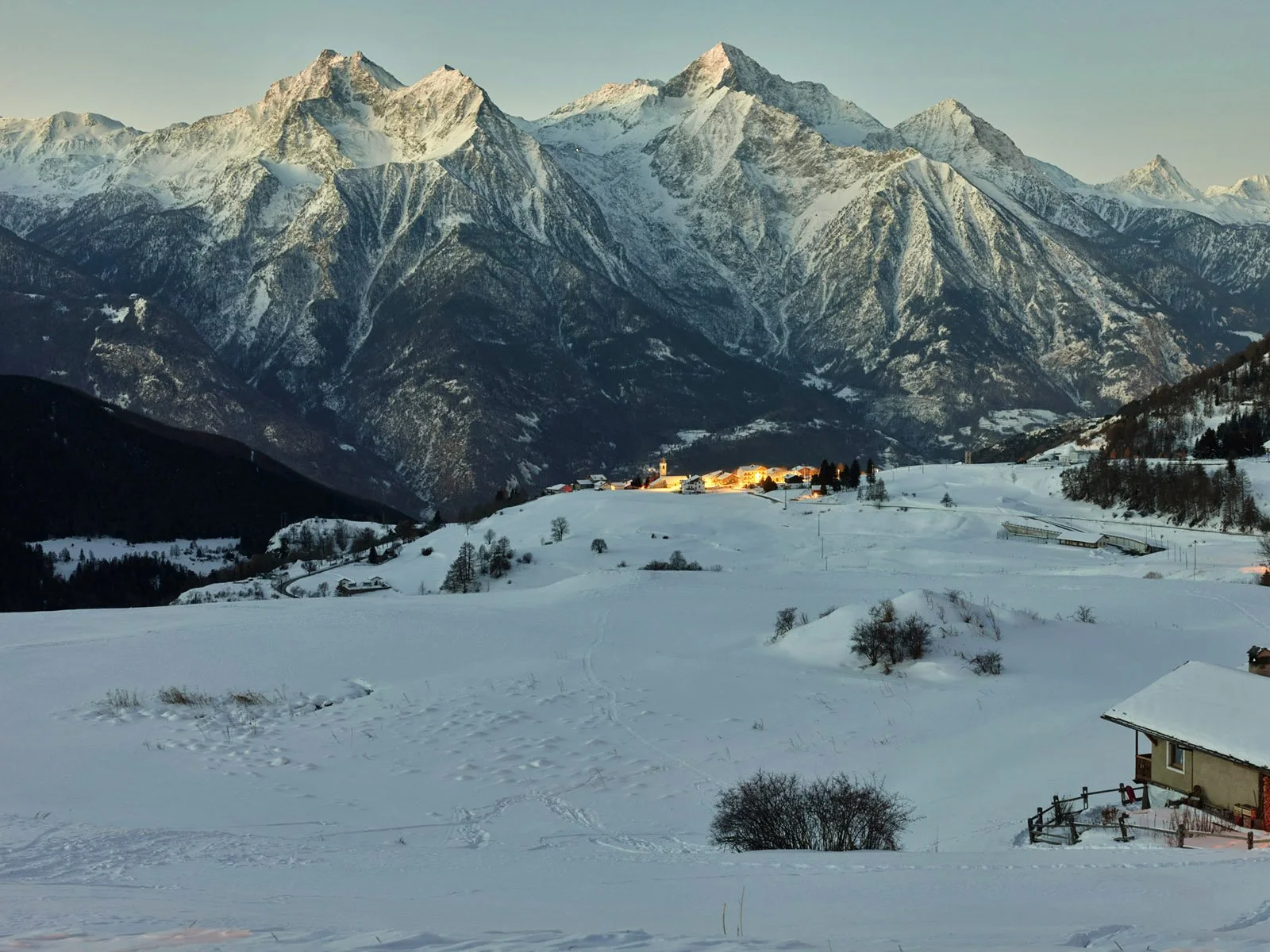


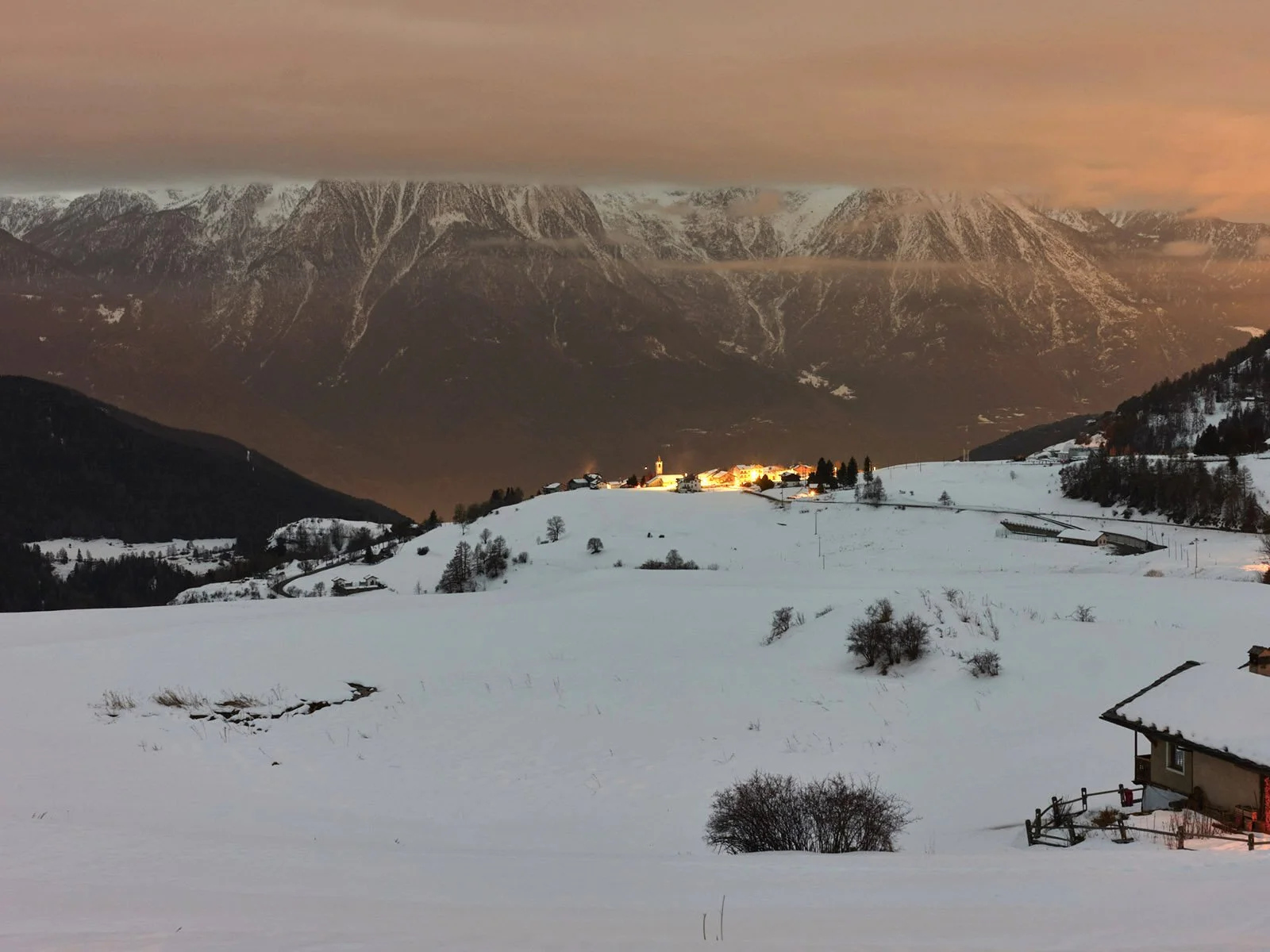


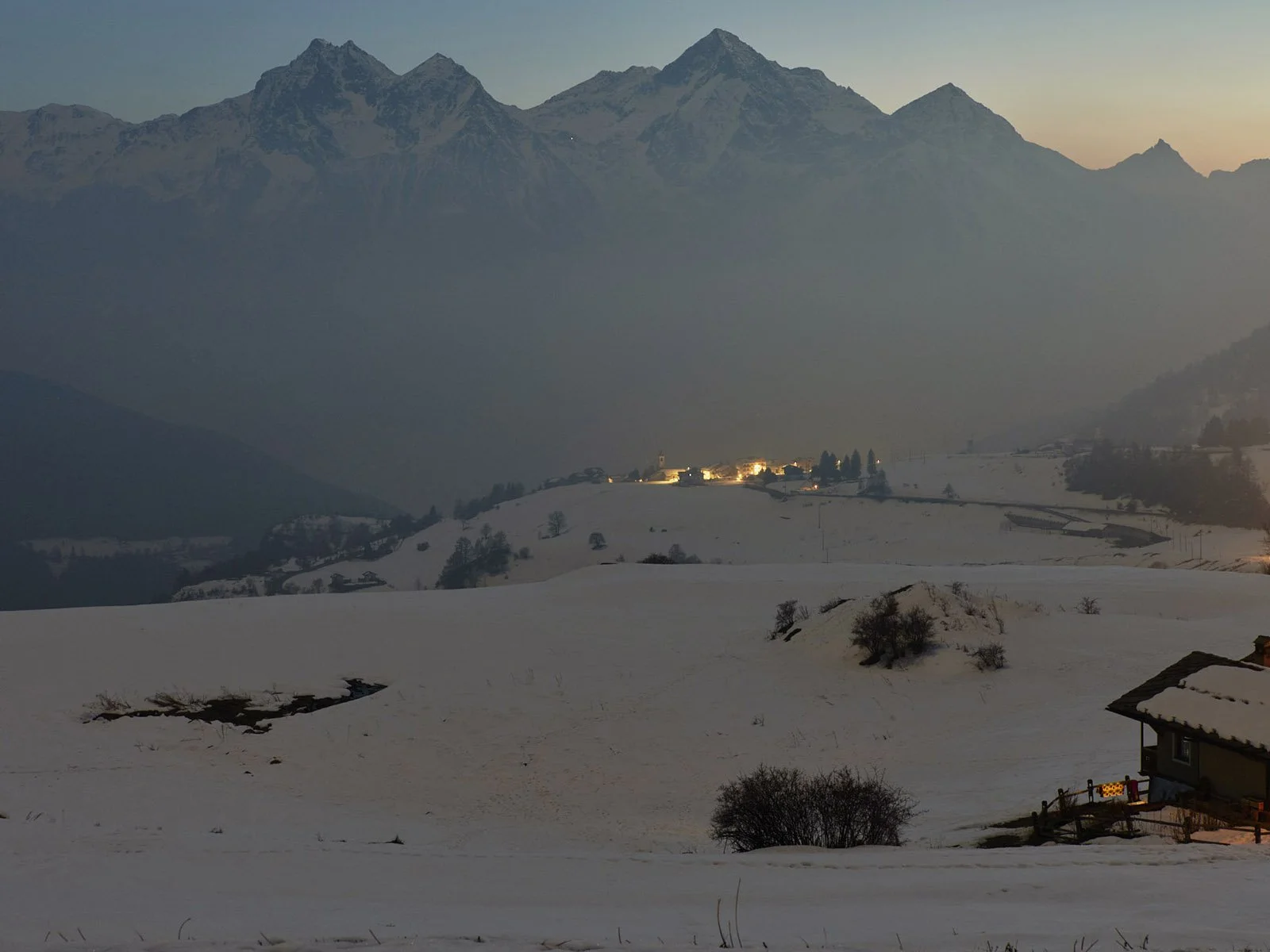


[Edition of 5+2 ap, 40x50 | 70x90 | 110x150 cm.]

Jan 12, 2021 | 07:13 | -9,62°
This work was conceived in a ritual form, to celebrate the beauty of the world through a symbolic, repeated action.
Thus, every day and for several months, I paid homage to the place where I was living, the Saint-Barthélemy valley in the municipality of Nus, in the Aosta province.
It is a tribute, but also a recipe for happiness, enacted at a precise moment of the day: after all, for a ritual to be valid, it must have an exact time in which it takes place; it cannot be performed whenever it is convenient.

Jan 31, 2021 | 07:00 | -9,49°
«It is a beautiful thing to have a gesture that repeats itself every day,
it is like having a frame that stays still,
and within it we can notice
how everything changes, inside and outside of us»
Chandra Livia Candiani
Il silenzio è cosa viva

Feb 4, 2021 | 07:02 | -8,39°
What has been kept constant, therefore, in addition to the framing, is the time of day. The number beneath the photographs – expressed in degrees – indicates the position of the sun in relation to the horizon line.
The span of time in which our star lies between 0° and −18° is called twilight [from the Latin crepusculum, derived from creper, meaning somewhat dark], and it is the interval in which day and night (and then night and day) relieve one another.

Jan 24, 2021 | 18:06 | -7,56°
A slash of Blue –
A sweep of Gray –
Some scarlet patches on the way,
Compose an Evening Sky –
A little Purple – slipped between –
Some Ruby Trousers hurried on –
A Wave of Gold –
A Bank of Day –
This just makes out the Morning Sky
(J 204 / F 233, c. 1860)
Emily Dickinson

Feb 8, | 06:48 | -9,83°
Twilight is a hinge: if it were to break, our world would collapse; it is the boundary that at once holds things together and keeps them apart.

Feb 9, 2021 | 18:41 | -9,79°
Mountains and plains
all are taken by the snow
nothing remains
Naito Joso
(1662-1704)

Feb 15, | 06:36 | -10,29°
Starting roughly in the seventeenth century, painting began to question how to render in the best possible way everyday events of extraordinary beauty, such as a sunrise, a sunset or clouds. Lorrain, Constable, Turner, the Barbizon school, the Impressionists and all the movements that followed, each of them added something.
With technological development new possibilities opened up; the English painter David Hockney decided to overcome the limitations of photography in order to achieve something more complete than a camera could ever do and thus – to convey the complexity of human vision – he used nine cameras all at once.
The way we see is extremely complex and layered. Not only do we have binocular vision, but we perceive space in a continuous way, adjusting the eye at every moment and then filtering everything through memory.
In short, it is a real mess; if one thought about it too much, one would never even take a single photograph, because any image is painfully inadequate when compared with reality.
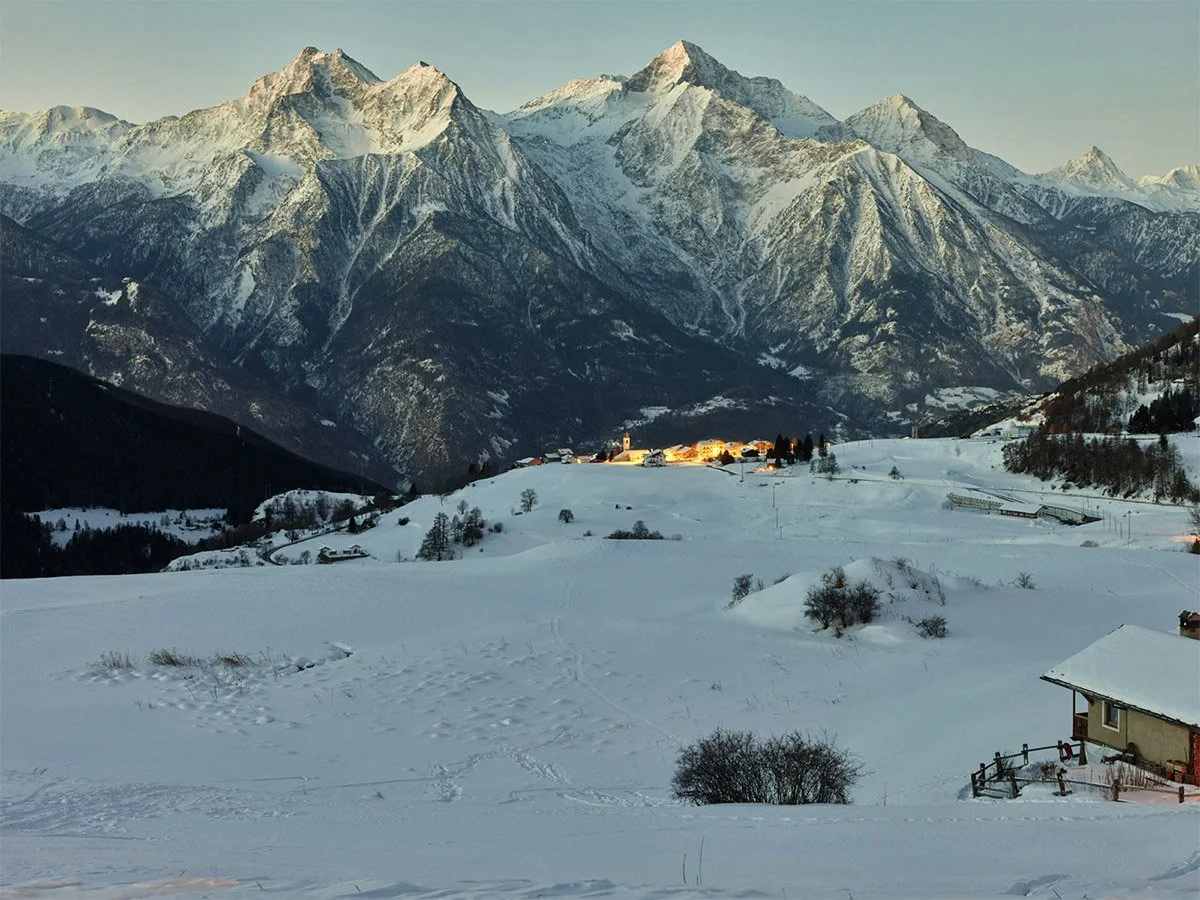
Jan 26, 2021 | 07:09 | -8,76°
Unlike Hockney, I only have one camera, so I worked with that.
Instead of capturing the same subject from many different viewpoints, I recorded the same scene for many days in a row.
Rather than multiplying the points of view, I multiplied the representations, keeping the gaze constant; it may be partial, incomplete and even approximate, but it is always the same one.
And it is within this continuity that one can then read the differences, from the most pronounced to the most subtle.

Feb 4, 2021 | 18:19 | -7,27°
[...]
Gentile questo venire giù dal cielo
suo garbato zittire le macchine operose
fare una bolla silenziosa
nel gran via vai del mondo.
Un grazie slarga il respiro
si spande in gioia per tutto il panorama
e dove l’occhio guarda forse risana. Ora.
da Per solitario andare
in Bestia di gioia
Mariangela Gualtieri
It is not possible to translate this poem without losing the beauty of its language, and therefore I present it only in the original version.

Feb 9, 2021 | 06:53 | -9,08°
The idea of always depicting the same subject is certainly not new.
Series devoted to a single theme were already well established in Eastern art; in Europe, those by Hokusai and Hiroshige had a particularly strong impact. Monet knew them, which is why in his lifetime he allowed himself to be enchanted at least four different times (the haystacks, the cathedral, the poplars and the water lilies).
Cézanne, on the other hand, only needed to see one mountain to swear lifelong fidelity to it.
The same was true for Georgia O’Keeffe; instead of Sainte-Victoire she fell in love with Cerro Pedernal, which she could see from her home in New Mexico, and she loved it so much that she said: “It is my private mountain. It belongs to me. God told me that if I painted it often enough I could have it.”
As for me, although I am in love with it, I do not believe that this landscape belongs to me; beautiful things are meant to be shared, not because they are beautiful, but because looking at them does us good, and feeling well is everyone’s right.

Jan 26, 2021 | 18:21 | -9,54°
I began working on this series of images when I started to feel that the approach I had taken to my work up to that point was not really adequate: it had become a sort of hunt, as if beauty were prey to be tracked down and – unsurprisingly – it was always a little further on; in the neighbour’s garden, in the next valley, in another region, across the border, beyond the sea.
I asked myself whether not being able to move around really compromised aesthetic research, and then I realised that the more I moved, the more I was in fact being distracted from the research itself and from the search for a subject that was always new. Beauty is already around us; it is everywhere, we just need to learn how to see it.
While reflecting on these things, I came to feel that the English verb to shoot is poorly suited to express the meaning of photography: we are not shooting at anything; it is not our gaze that flies like an arrow towards the world, but rather the world that projects itself towards us, and then there is nothing left to do but gather photographs, just as one gathers fruit.
French comes closer – prendre une photo – it conveys the idea quite well. Spanish too – tomar – uses a beautiful verb that works; it is used both for drinking and for taking a photograph, and in fact the camera, when it opens the shutter, allows the world to pour into it.

Feb 10, 2021 | 06:51 | -8,86°
There is something faintly wild in the aesthetic quality of the world.
Sometimes it is better to remain still and let it come towards us, rather than dressing up as adventurers and going anywhere at all just to find it.
It takes a certain gentleness: one must know how to wait, to be sniffed out and, finally, to be welcomed.
“Things have to visit you; it is useless to go looking for them,” Carmelo Bene used to say, and perhaps he was right.

Jan 21, 2021 | 18:10 | -8,77°
At first the mountains are mountains and the valleys are valleys
Then the mountains are no longer mountains and the valleys are no longer valleys
In the end the mountains are mountains and the valleys once again valleys
-
Zen saying

Jan 28, 2021 | 18:20 | -9,06°
There are three types of twilight; here only nautical twilight has been considered.
It has this particular name because if we were at sea, with a clear sky, a sextant (and the proper knowledge) would make it possible to determine our position, still looking at the stars and already at the world around us.
It is a moment of cosmic equilibrium; these are the only instants in the day when we have essentially the same amount of light in the sky and on the earth. We are equally distant from night and from day.
Ideally this moment occurs when the sun is at −9° below the horizon line; however, cloud cover and the shape of the terrain can shift things by a few degrees.

Jan 24, 2021 |07:21 | -7,02°
Sitting quietly
doing nothing
spring comes
and the grass grows by itself
-
Zenrin kushu

Feb 3, 2021 | 18:22 | -7,98°